
- home
- About us
- product
- news
- download
- contact us

2026/09/05
Let's start with the fun part: appearance.
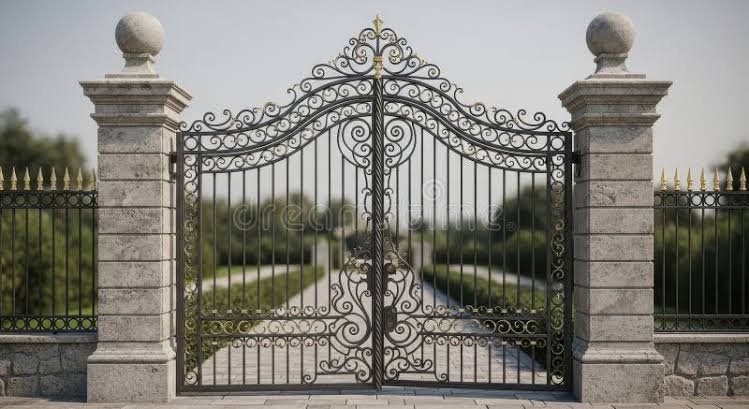
Wrought iron is often the favorite when you want a gate that makes a statement.
Imagine a large black gate with graceful curves and decorative details. It doesn't just close the driveway—it becomes part of the architecture.
Steel tends to have a cleaner, more modern personality.
Think straight lines, simple frames, horizontal slats, or large geometric panels.
Elegant + decorative + timeless
Modern + clean + minimalist
Of course, there are no strict rules. A well-designed wrought iron gate can look extremely modern, while a steel gate can also include beautiful decorative details.
This is where things get interesting.
Many people assume that one material must automatically be stronger than the other.
In reality, the design and construction of the gate matter enormously.
A strong gate needs more than strong metal.
The manufacturer should consider:
Frame size
Material thickness
Bar diameter
Welding quality
Hinge strength
Locking system
Gate dimensions
Installation method
For example, a large driveway gate with a heavy frame needs stronger hinges and properly designed posts.
So instead of asking only:
“Is wrought iron stronger than steel?”
A better question is:
“How is the gate constructed?”
That's what really matters when security and long-term performance are important.
Yes, both can rust if the metal is exposed to moisture for a long time without adequate protection.
But don't let that put you off.
A properly finished outdoor metal gate can be highly resistant to weather and corrosion.
Two common protection methods are hot-dip galvanizing and powder coating.
Galvanizing adds a protective zinc layer to the metal.
It is widely used for outdoor fences, gates, railings, and other metal products because it helps protect the underlying metal from corrosion.
Powder coating adds a durable decorative finish.
It also gives you plenty of design choices, including black, white, gray, bronze, and many other colors and textures.
For demanding outdoor environments, galvanizing combined with powder coating can provide an attractive and durable finish.
So when comparing two gates, don't simply ask:
“Is it wrought iron or steel?”
Also ask:
“How is it protected against corrosion?”
That question can save you a lot of trouble later.
This one is easy:
Both can be highly customized.
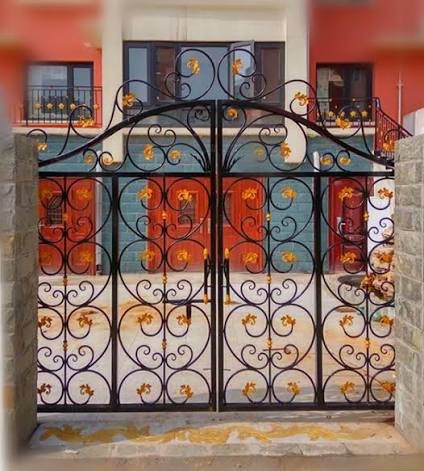
But wrought iron is especially popular when decorative details are important.
For example, you could create a gate with a custom:
Height and width
Arch
Scroll pattern
Floral motif
Geometric design
Decorative finials
Fence pattern
Color
Surface finish
You can even design the gate and fence together.
Imagine walking toward a villa where the driveway gate, pedestrian gate, and surrounding fence all share the same pattern.
The result feels intentional rather than pieced together.
That's one of the biggest advantages of custom manufacturing.
Here's some good news:
Neither type needs to be difficult to maintain.
A quality outdoor gate with proper surface treatment generally requires relatively little maintenance.
Every so often, take a quick look for:
Scratches
Peeling or damaged coating
Rust spots
Loose hinges
Damaged hardware
Areas where water tends to collect
If you spot a small problem, deal with it early.
A tiny scratch is much easier to repair than a large area of corrosion that has been left untreated for years.
And if the gate is installed in a coastal or high-humidity area, choosing an appropriate surface treatment becomes even more important.
This is probably the question every buyer wants answered.
Unfortunately, there isn't a simple answer.
The final price of a metal gate depends on much more than the material.
For example:
A simple gate with a basic design can be relatively affordable.
But add a large size, intricate decorative patterns, thick materials, special finishes, custom hardware, and complicated packaging—and the price can increase quickly.
The cost may depend on:
Gate size
Material thickness
Design complexity
Decorative elements
Welding and fabrication
Surface treatment
Hardware
Quantity
Packaging
Shipping
So don't compare two quotations based only on the words “wrought iron” and “steel.”
Compare the complete specifications.
Otherwise, you may end up comparing two completely different products.

A beautiful gate still needs to work properly.
Large metal gates can become quite heavy, especially when they have thick frames, solid panels, or extensive decorative elements.
That weight affects the:
Hinges
Posts
Locks
Gate opener
Installation structure
If you're installing a large driveway gate, make sure the supporting posts and hardware are designed for the actual gate weight.
Planning to use an automatic gate opener?
Then the gate's size and weight become even more important.
A good manufacturer should be able to provide the necessary information before production begins.
If you're designing a villa entrance and want people to notice the gate before they notice the house, wrought iron is hard to beat.
A large arched gate with decorative details can instantly create a luxurious entrance.
It also pairs beautifully with:
Stone walls
Brick columns
Landscaping
Driveways
Garden fences
European-style architecture
For a modern villa, you don't have to choose an ornate design.
A minimalist wrought iron gate with straight lines and a matte black finish can look just as impressive.
If security is your top priority, don't make your decision based on material alone.
A secure gate is a complete system.
The design should take into account:
Gate height
Frame construction
Bar spacing
Material thickness
Welding
Hinges
Locking system
Posts
Installation
Steel is often selected for heavy-duty security applications because of its structural properties.
But a properly designed wrought iron gate can also provide excellent security.
And unlike many purely functional security barriers, it can still look beautiful.
Why choose between security and style when you can have both?
Here's the easiest way to decide.
A classic or elegant entrance
Decorative details
A luxury villa appearance
Custom ornamental designs
A traditional or European-inspired style
A gate that becomes part of your home's character
A modern appearance
Clean geometric lines
High structural strength
A minimalist design
A heavy-duty application
A practical solution for modern projects
Start with the look you want, then consider the structure, environment, budget, and surface treatment.
The best gate isn't necessarily the most expensive one.
It's the one that fits your property and does what you need it to do.
Every property is different.
The driveway might be wider than standard sizes. The fence may have a unique pattern. The architect may have a specific design in mind.
That's where custom manufacturing becomes valuable.
A custom wrought iron gate can be made according to your:
Dimensions
Drawings
Reference pictures
Design preferences
Material requirements
Frame specifications
Bar thickness
Color
Surface treatment
Hardware
Installation requirements
For homeowners, this means more freedom.
For contractors, architects, developers, and importers, it means the gate can be produced to match the requirements of a specific project.
Even a simple reference picture can be a good starting point.
So, wrought iron gate or steel gate—which is better?
The truth is, neither one is automatically better for every project.
A wrought iron gate is an excellent choice when you want character, elegance, decorative design, and customization.
A steel gate is a great option when you want modern styling, structural strength, and practical functionality.
And for both, the quality of the design, welding, hardware, and surface treatment can make a huge difference.
Think about the entrance to your property.
Do you want people to think:
“That's a beautiful gate.”
Or:
“That's a strong gate.”
With the right design, you don't necessarily have to choose.
You can have a gate that looks beautiful and performs beautifully, too.
Have a design in mind?
Send us your drawing, reference picture, dimensions, or project requirements.
We can help you turn your idea into a custom wrought iron gate designed for your project.
Contact us today for a customized quotation.