
- home
- About us
- product
- news
- download
- contact us

2026/09/24
A wrought iron gate can look strong and beautiful for many years. But sometimes, a strange problem appears: the gate gradually becomes harder to open and close.
At first, you may only notice a little resistance. Then you need to push harder. Eventually, the gate may scrape against the ground, get stuck, or refuse to close properly.
Is the gate too heavy? Is it the hinge? Is it rust?
The answer could be any of these—or several problems happening at the same time.
Here are the most common reasons why a wrought iron gate becomes difficult to operate.
Hinges are one of the most important parts of a swinging wrought iron gate.
When the hinges are installed correctly, the gate can move smoothly around its pivot point. But if the hinges are not aligned vertically, even a small installation error can create significant resistance.
Over time, the problem may become more noticeable because the weight of the gate continuously puts stress on the hinge system.
Typical signs include:
The gate feels heavier when opening.
The top or bottom of the gate moves sideways.
The gate rubs against the frame.
The hinge makes unusual noises.
For large or heavy gates, proper hinge positioning is especially important.

A wrought iron gate can be surprisingly heavy, especially when it has a large frame, decorative elements, thick steel sections, or a solid design.
If the hinges or supporting structure cannot handle the load properly, the gate may gradually sag.
You might notice that the bottom corner of the gate is getting closer to the ground.
Eventually, the gate may scrape against the driveway or threshold every time you open it.
This is one reason why gate weight, frame construction, and hinge capacity should be considered together, rather than separately.
Outdoor wrought iron gates are constantly exposed to rain, humidity, temperature changes, and other environmental conditions.
If the surface protection is damaged or inadequate, rust can begin to develop.
Rust does more than affect appearance. It can also:
Increase friction around moving components
Damage hinge surfaces
Cause metal expansion and roughness
Weaken certain parts over time
A properly prepared and protected surface can significantly reduce these problems.
For outdoor gates, surface treatment is therefore not simply about making the gate look good. It is also part of long-term performance.

Metal is strong, but that does not mean a gate can never deform.
Repeated use, impact, poor welding, structural stress, or improper installation can cause a gate frame to become slightly distorted.
The deformation may be difficult to notice with the naked eye.
But even a small change in the frame can affect the gap between the gate and its surrounding structure.
You may suddenly find that:
The gate used to open perfectly, but now one corner starts rubbing against the frame.
When this happens, simply applying more lubricant may not solve the underlying problem.
Sometimes, the gate itself is not the problem.
The ground, driveway, wall, or gate posts may move slightly over time.
For example, soil settlement can change the position of the gate posts. Concrete can also move or crack under certain conditions.
Because the gate is attached to these structures, even a small movement can change its alignment.
This is particularly important for large entrance gates, where a small change at the hinge side can create a much larger problem at the opposite end.
A beautiful wrought iron gate can contain a lot of metal.
Imagine a large double gate with:
A heavy steel frame
Decorative scrolls
Thick infill bars
Additional security elements
Heavy surface coatings
The final weight can be substantial.
If the hinges, posts, bearings, or other hardware are not selected according to the actual gate weight, the gate may become difficult to operate.
This is why a good gate design should consider the entire system, not just the appearance.
The gate, hinges, posts, frame, and installation method all need to work together.

Even a well-made wrought iron gate needs some basic maintenance.
Moving parts should be checked periodically. Hinges should be inspected for wear, and damaged surface coatings should be repaired before corrosion spreads.
A simple maintenance routine can help identify small problems before they become expensive repairs.
For example, if you notice that your gate is slightly harder to open than it was six months ago, don't wait until it becomes completely stuck.
That small change could be an early warning sign of hinge wear, alignment problems, or structural movement.
The best solution is to prevent the problem during the design, manufacturing, and installation stages.
A large gate needs enough structural strength to support its own weight without unnecessary deformation.
Hinge capacity should match the actual gate weight and size. Heavy gates may require more robust hinge systems.
Poor fabrication can create distortion and alignment problems.
Accurate cutting, proper welding, and careful assembly help keep the gate frame stable and correctly aligned.
For outdoor applications, appropriate surface preparation and protective coating are important for reducing corrosion.
Depending on the application, options may include galvanizing and powder coating or other suitable systems.
Even a well-manufactured gate can perform poorly if the posts are not properly positioned or the hinges are incorrectly installed.
Installation accuracy matters just as much as manufacturing quality.
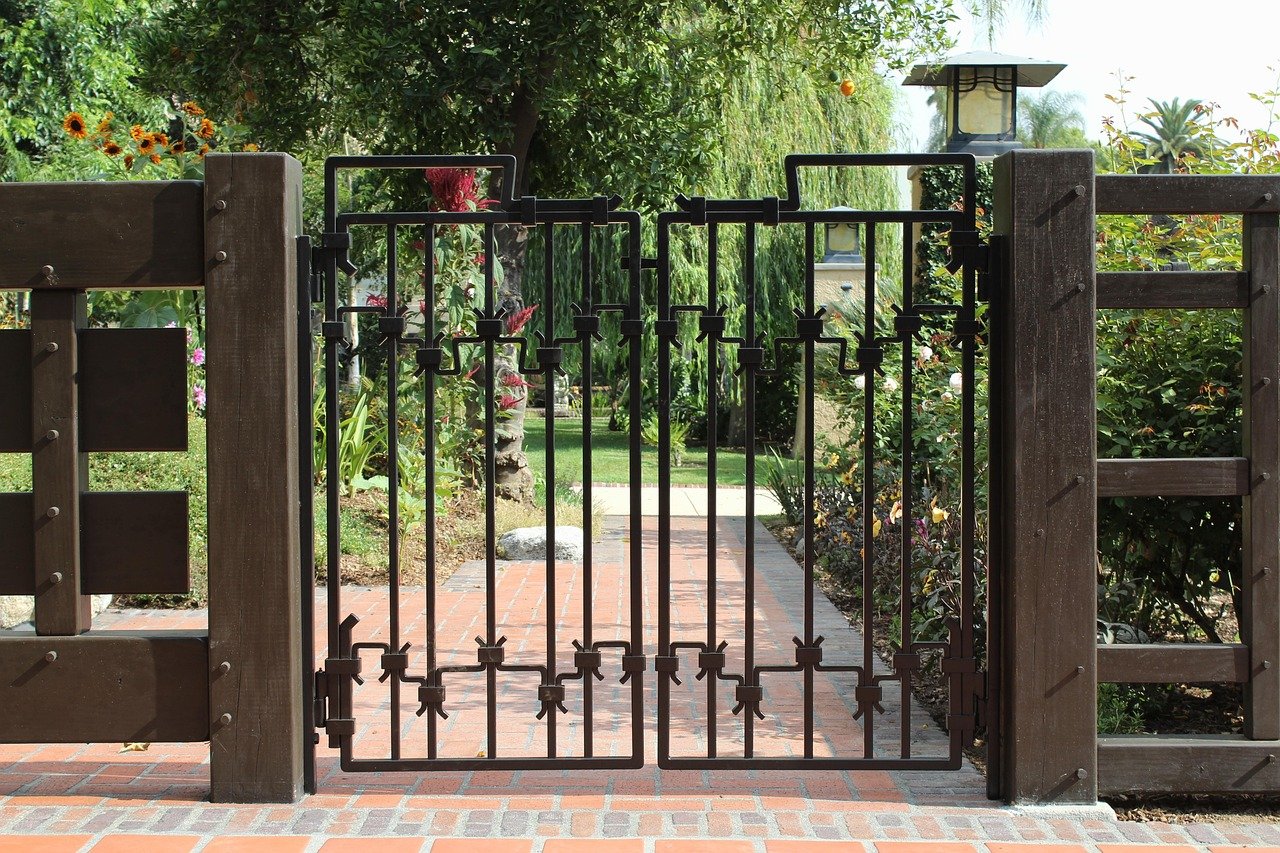
A wrought iron gate may be heavy by nature, but it should not feel unnecessarily difficult to operate.
If a properly designed gate suddenly becomes hard to open, there is usually a reason.
It could be a hinge problem, gate sagging, corrosion, frame deformation, ground movement, or simply a mismatch between the gate and its hardware.
The important thing is to find the actual cause rather than simply forcing the gate harder.
A well-designed wrought iron gate combines strength, accurate fabrication, suitable hardware, proper surface treatment, and correct installation.
That combination is what allows a heavy gate to remain smooth and reliable for years.
If you are purchasing a wrought iron gate for a home, commercial building, villa, or entrance project, don't look only at the design.
Ask about the material, frame construction, hinge system, surface treatment, fabrication process, and installation requirements.
These details may not be obvious in a product photo, but they can make a major difference after the gate has been installed for several years.
A good-looking gate is important.
But a gate that still opens smoothly years later is even better.